The AI Revolution: Skills, Productivity, and the Future of Work
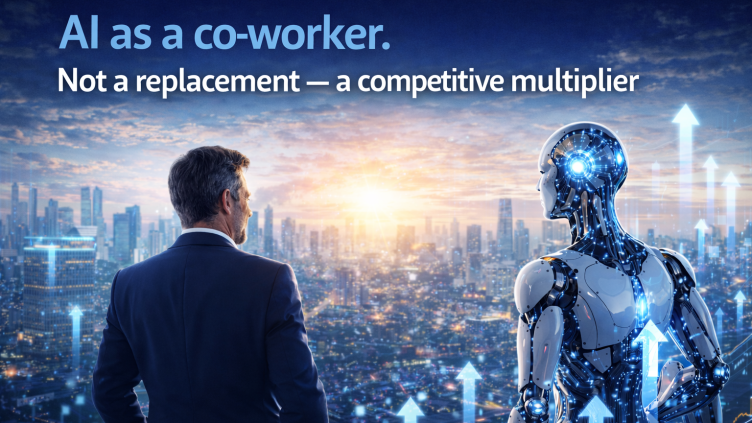
Why leaders must rethink now, between structural change and opportunity
Artificial Intelligence is no longer a future topic. It has arrived, and it is reshaping how work is organized, how skills are developed, and how value is created.
The reflections below are based on publicly available data, cross-industry observations, and global research, not on any single organization, employer, or internal situation.
Over recent weeks, two broader trends have become increasingly visible across industries:
Many large corporations are accelerating productivity and efficiency programs, often enabled by automation and AI.
At the same time, knowledge-intensive sectors are openly discussing an unintended side effect: while AI removes routine work, it also challenges traditional models of skill development.
Taken together, this points to a structural shift, not a short-term cycle, one that affects leadership, talent development, and organizational design across sectors.
Beyond general productivity trends, recent public data from the United States and professional services firms adds important context.
In the U.S. alone, more than 100 companies have filed WARN notices for workforce reductions planned for 2026, according to publicly available state and federal disclosures. These filings span technology, logistics, manufacturing, retail, and professional services, indicating that workforce restructuring is not isolated to a single sector, but part of a broader adjustment to productivity and cost structures enabled by automation and AI.
At the same time, professional services firms are openly acknowledging structural changes in entry-level work.
Ernst & Young (EY), for example, has publicly stated that AI is increasingly taking over routine analytical tasks, documentation, and first-draft deliverables that were historically part of junior development paths. Similar dynamics have been discussed by other Big Four firms, where AI-supported workflows are reshaping how early-career professionals learn, contribute, and progress.
Importantly, these developments are not framed as short-term cost-cutting exercises, but as responses to:
sustained productivity gains through AI-enabled tools
changing client expectations around speed and efficiency
pressure to redesign operating models for long-term resilience
Together, these signals reinforce a key point:
The current wave of workforce adjustments is less about cyclical downturns — and more about structural productivity realignment.
For leadership teams, this shifts the core challenge away from headcount decisions alone and toward a more difficult question:
How do organizations preserve capability development and decision quality while redesigning work around AI-enabled productivity?
1. Productivity acceleration: A structural shift, not a short-term signal
Across industries, organizations are redesigning processes, roles, and operating models to improve productivity and resilience.
Public announcements from global companies highlight a consistent pattern: AI and automation increasingly take over activities such as:
repetitive analysis
standard reporting
operational coordination
elements of planning and forecasting
Where productivity increases structurally, traditional role profiles inevitably change.
This is not primarily about economic downturns. It reflects a reallocation of work driven by technology.
From a leadership perspective, this raises a fundamental question:
How do we redesign roles and careers when execution becomes cheaper, but judgment, context, and decision quality become more valuable?
2. The learning challenge: When efficiency changes how skills are built
The discussion within professional services firms provides a useful illustration.
In many organizations, AI systems now support tasks that were historically part of early career development:
data preparation
research
baseline analyses
first drafts of reports and models
The efficiency gains are real and measurable.
At the same time, organizations are recognizing that learning mechanisms must evolve.
Previously, expertise often developed through repetition, manual effort, and incremental responsibility. Today, learning increasingly happens through:
interpreting AI outputs
validating assumptions
understanding system limitations
applying judgment rather than execution
This shift is manageable, but only if learning is designed intentionally.
That includes:
redesigned development paths
stronger mentoring
explicit space for deep understanding, not just speed
Without this, there is a risk of shallow expertise, not because people are less capable, but because learning models lag behind technology.
3. A leadership reality: AI adoption is no longer optional, but how it’s used matters
Avoiding extremes is critical.
This is not about alarmism. But it is also not a neutral development.
For leaders
AI cannot be treated as a purely technical topic or fully delegated.
Leadership teams increasingly need to understand:
where AI genuinely improves decisions
where human judgment remains essential
how productivity and capability development interact
Organizations that approach AI systematically will adapt faster than those that treat it as an isolated tool.
For professionals
Routine work alone is no longer a differentiator.
Value increasingly comes from:
interpretation
contextual judgment
responsibility for outcomes
AI becomes an amplifier, not a replacement, for those who learn to work with it deliberately.
For organizations
AI adoption without role redesign and capability investment creates short-term efficiency, but long-term risk.
The real challenge is not technology. It is organizational learning speed.
4. The opportunity: AI as a co-worker, not a shortcut
Used well, AI strengthens organizations rather than hollowing them out.
What increasingly distinguishes successful approaches:
Leadership focus
building personal AI literacy
integrating AI into decision processes
measuring learning and capability, not just output
Workforce development
combining domain expertise with AI support
maintaining human ownership of decisions
treating validation and judgment as core skills
Organizational design
shifting roles from execution to evaluation and design
reinvesting productivity gains into reskilling
moving beyond pilots toward coherent operating models
The most resilient organizations do not use AI primarily as a cost lever. They use it to extend human capability.
Final reflection
AI is reshaping work, regardless of individual preferences or organizational readiness.
The defining question is not whether roles change, but how consciously that change is designed.
Organizations that focus only on efficiency may gain speed, but lose depth. Those that invest in learning, leadership, and redesign build durable advantage.
AI is not a threat scenario. It is a leadership and design responsibility.
#AI #FutureOfWork #Leadership #DigitalTransformation #SkillDevelopment #GrowthMindset #ArtificialIntelligence #WorkforceTransformation
References (Harvard Style)
Amazon.com, Inc. (2025). Company announcements and workforce updates. Available at: [https://www.aboutamazon.com](https://www.aboutamazon.com) (Accessed: 25 January 2026).
Business Insider (2025). How AI is changing junior roles at Big Four firms. Available at: [https://www.businessinsider.com](https://www.businessinsider.com) (Accessed: 25 January 2026).
Microsoft Corp. (2025). Workforce adjustments and AI strategy. Available at: [https://www.microsoft.com/investor](https://www.microsoft.com/investor) (Accessed: 25 January 2026).
Reuters (2025). Major U.S. companies announce job cuts amid AI-driven restructuring. Available at: [https://www.reuters.com](https://www.reuters.com) (Accessed: 25 January 2026).
World Economic Forum (2024). Jobs of Tomorrow: Large Language Models and Jobs. Geneva: WEF.
World Economic Forum (2025). The Future of Jobs Report 2025. Geneva: World Economic
World Economic Forum (2024). Jobs of Tomorrow: Large Language Models and Jobs. Geneva: World Economic Forum.
World Economic Forum (2025). The Future of Jobs Report 2025. Geneva: World Economic Forum.
McKinsey & Company (2025). The State of AI: Global Survey 2025. McKinsey & Company.
Business Insider (2025). How AI is changing junior roles at Big Four firms. Available at: https://www.businessinsider.com (Accessed: 25 January 2026).
Reuters (2025). Major U.S. companies announce job cuts amid AI-driven restructuring. Available at: https://www.reuters.com (Accessed: 25 January 2026).
OECD (2024). Artificial Intelligence, Automation and Work. Paris: OECD Publishing.
Gartner (2025). AI’s Impact on Workforce Skills and Organizational Design. Gartner Research Note.
Autor, D., Mindell, D. and Reynolds, E. (2022). The Work of the Future: Building Better Jobs in an Age of Intelligent Machines. Cambridge, MA: MIT Press.
